
By: David Armes & Jessica Nielsen.
Mid-June is one of those deadlines that doesn’t feel like a deadline. April 15 has the weight of the entire tax year behind it: the news coverage, procrastination, and the late-night TurboTax sessions the day before. June 15 is just a quarterly. Some CEOs don’t have it on their personal calendar at all, which is one of the more expensive oversights in private-company accounting. It’s the Q2 estimated tax payment deadline, it lands at the operational midpoint of the year, and it’s the first real test of whether the back office is keeping up with the business. If you filed an extension back in April and told yourself October was the deadline you really had to worry about, then let’s revisit that assumption and take a look at the tax information you need to know if you run a business.
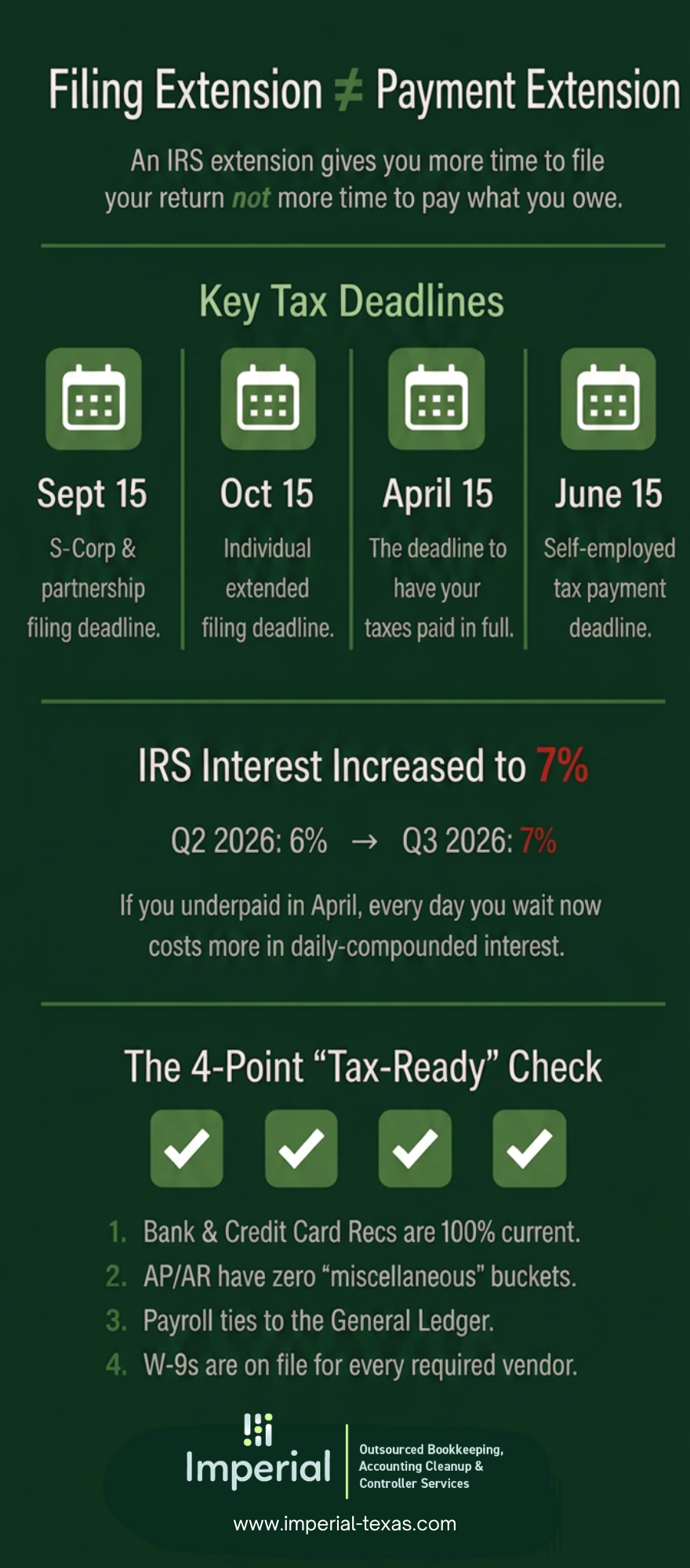
The biggest misunderstanding of tax extensions is that it only extends your filing deadline, not your payment deadline. This piece causes the most financial pain because you don’t have to file your taxes, but you do have to make your estimated payments. Form 7004, the standard six-month automatic extension for business returns, says it directly in the IRS instructions: “The extension will be granted if you complete Form 7004 properly, make a proper estimate of the tax (if applicable), file Form 7004 by the due date of the return for which the extension is requested, and pay any tax that is due.” The “pay any tax that is due” part is what most people forget. Whatever you owed, you owed on the original due date. Pay 90% or more by then, and the extension keeps you out of the failure-to-pay penalty. Pay less, and the 0.5% per month failure-to-pay penalty kicks in alongside daily-compounded interest, both running from April. Extensions themselves aren’t bad. Most companies file them, and the IRS makes them easy for a reason. The point is that an extension only works for businesses that paid an accurate estimate at the original deadline, and an accurate estimate is only as good as the books behind it. Make sure you know your tax calculations.
Business Tax Deadline Calendar
If your fiscal year is the calendar year and you have a typical mid-market company, here’s what the year should look like:
- April 15: Q1 estimated tax payments are due.
- June 15: Q2 estimated tax payments are due.
- September 15: Q3 estimated payments are due, alongside the extended filing deadline for partnerships filing Form 1065 and S corporations filing Form 1120-S.
- October 15: Extended filing deadline for C corporations filing Form 1120 and individual returns on extension.
- January 15, 2027: Q4 estimated tax payments are due.
- March 15, 2027: Partnerships and S Corporations federal tax return deadline.
- April 15, 2027: C Corporations & Sole Proprietorships.
Each of those dates carries a different interest rate, because the IRS sets the underpayment rate quarterly based on the federal short-term rate plus three percentage points. We’ve gone from 8% across all of 2024, to 7% for most of 2025, to a one-quarter dip to 6% in Q2 2026, and back up to 7% in Q3 2026, per IRS Revenue Ruling 2025-22 and the subsequent quarterly announcement. The trend is important because if you’ve been carrying an underpayment from April, the Q3 rate change just made it more expensive to keep carrying it. Daily compounding makes the math worse than the headline rate suggests. A $100,000 underpayment carried from April 15 to October 15 at the prevailing rates accrues somewhere north of $3,300 in interest alone, before any failure-to-pay penalty, which can add up to 25% of the unpaid balance.
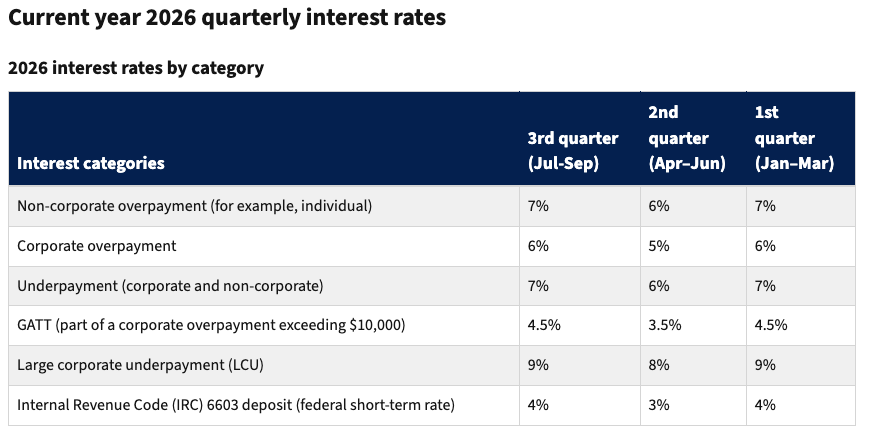
IRS 2026 Interest Rates Table from irs.gov.
What does a “tax-ready” back office look like?
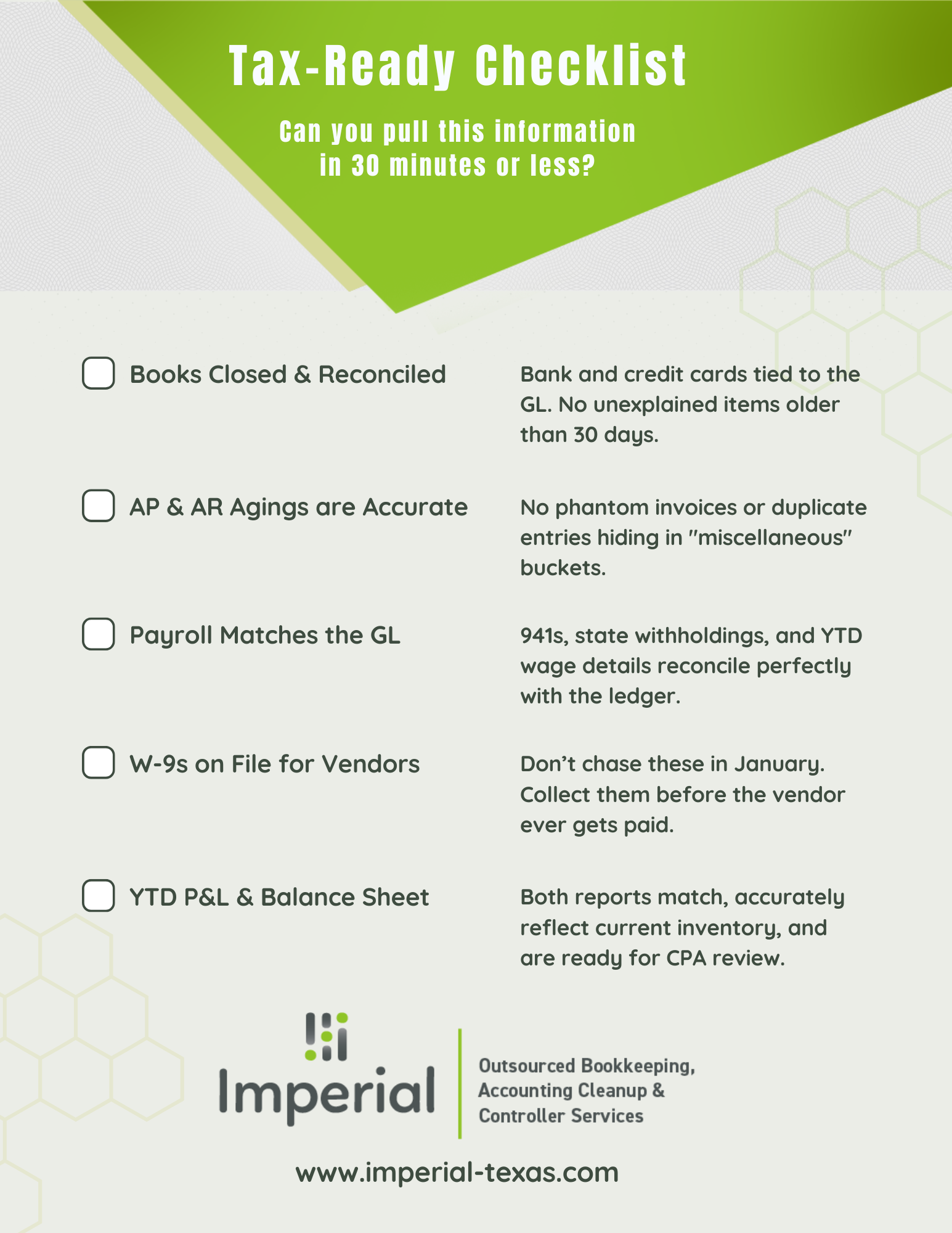
Tax-ready is a phrase your CPA uses casually and rarely defines. In our work running cleanups and fractional controller engagements, here’s what it actually looks like in practice. Your books are closed through the most recent month, which means the period is locked, journal entries are posted, and the trial balance ties. Your bank reconciliations are current, every account, every month, with no outstanding items older than 30 days without an explanation. Your credit card statements have been reconciled to the GL the same way, because rolling balances on corporate credit cards are a favorite hiding spot for the kinds of misclassified expenses that turn into audit findings later.
Your accounts payable aging is accurate, and there are no $50,000 invoices floating in a “miscellaneous” bucket because the project manager who knew the detail left the company in March. Your accounts receivable aging is the same: no phantom invoices, no duplicate entries, no customers who paid you in cash six months ago and never got their balance cleared. Payroll has been reconciled to the general ledger, including 941s, state withholdings, and year-to-date wage detail. Your 1099 vendor list is current and you have W-9s on file for every vendor who needs one, which in the mid-market AP files we audit is somewhere between 65-75% of where it should be. And the year-to-date P&L and balance sheet you can pull right now match each other and reconcile to bank, AP, AR, and inventory if you carry it. If you can’t pull all of that with confidence in 30 minutes, then your books aren’t ready, regardless of what your accounting software dashboard says.
All of this is mechanically important to the tax deadline. Your CPA calculates estimated payments and final tax liability from the financials you give them. If those financials are off because the bank reconciliation is six months behind, or the AP detail double-counts vendors, or the inventory account hasn’t been adjusted since last September, the estimated payment is going to be wrong. Wrong on the low side, the IRS starts charging interest from the original due date. Wrong on the high side, you’ve handed the government an interest-free loan you don’t get to call back until you file. Neither is good, and neither is the CPA’s fault, because the CPA can only work from what’s in front of them. We’ve watched plenty of competent CPAs build immaculate returns on the back of bad inputs, and the returns are exactly as accurate as the inputs allow. If you want to know more about the specific tax regulations and credits, Grant Thornton has an extensive tax planning guide and BDO has year-end guides for both public and private companies.
Tax Ready Back Office Checklist:
- Books are closed
- Bank reconciliations are current
- Credit Card reconciliations are current
- AP aging is accurate
- AR aging is accurate
- Payroll reconciled
- 1099s and W-9s on file
- YTD Profit & Loss (P&L) and Balance Sheet are up to date
Where the back office fits and where it doesn’t
Imperial is not a CPA firm. We don’t file your taxes, we don’t sign your return, and if you ask us for tax planning advice, we’ll point you back to your CPA. We do the work that happens before the CPA gets the file, which is the part most companies don’t invest enough time in until it’s too late. We do catch-up bookkeeping for businesses that are months, quarters, or even years behind, which is more common than anyone in the industry wants to admit.
We do month-end controller oversight, the senior-level review that catches misclassified entries and missing accruals before they end up on a financial statement. We do reconciliation work across multi-entity structures where the intercompany accounts haven’t tied since the second LLC was set up in 2023. We clean up vendor master files and chase down the missing W-9s, because that’s a January 31 problem (the 1099-NEC filing deadline) that is much cheaper to solve in June than it is in December.
And we coordinate with your existing CPA so they get clean books instead of an expensive forensic puzzle. This is how we frame it: your CPA’s job gets exponentially harder when the books aren’t clean, and the cost of that difficulty shows up either in higher fees or in returns filed against data that’s not accurate. Our job is to make sure neither of those happens.
What do I do about my business taxes now?
The deadlines are above, and one just passed as of publishing. The realistic path forward isn’t to clean up six months of books tomorrow. That’s not honest advice. If you really want to be ready for taxes, getting business loans, or a sale (you should always be ready for all of these, even if it’s not your goal), you need your financials in top shape. The best next step is to answer four questions:
- Can you pull a current P&L and balance sheet right now, without calling someone?
- Is your most recent month actually closed and reconciled, or just mostly closed?
- Has anyone calculated the Q2 estimated payment based on current-year numbers, or is your CPA working off last year’s tax return as a safe-harbor estimate (which is legal, but often leaves money on the table or creates a Q4 catch-up problem)?
- If the answer to any of those is no, then what is the plan to fix it before the partnership and S-Corp filings come due on September 15?
If you don’t have answers, then June 15 is the smaller problem. The bigger problem is the September and October filing deadlines, which require books that are actually closed through August, not “mostly there.”
That summer window between June and August is the smart time to do the cleanup work that makes Q3 and Q4 filing painless. Summer business is often slow and no one is thinking about taxes. The companies that don’t are the ones we tend to end up talking to in October, when there are no good options left and every CPA in town is fully booked. If you’re somewhere on that spectrum and want to know where you stand, that’s the conversation worth having before you end up with a mess.
Schedule a diagnostic with Imperial and let’s take an honest look at where the books are right now. Bring whatever you have. If they’re already in good shape, we’ll tell you and we won’t waste your time. If they aren’t, you’ll walk out knowing exactly what’s in front of you and how long it will take to fix.
Sources for more reading:
IRS – Instructions for Form 7004 (Application for Automatic Extension of Time To File Certain Business Income Tax, Information, and Other Returns) – https://www.irs.gov/instructions/i7004
Cerini & Associates, LLP – Estimated Tax & Safe Harbor Strategy – https://ceriniandassociates.com/estimated-tax-safe-harbor-strategy/
IRS – Interest rates remain the same for the first quarter of 2026 (IR-2025-112, Nov. 13, 2025) – https://www.irs.gov/newsroom/interest-rates-remain-the-same-for-the-first-quarter-of-2026
IRS – Revenue Ruling 2025-22 (Q1 2026 interest rates) – https://www.irs.gov/pub/irs-drop/rr-25-22.pdf
IRS – Quarterly interest rates – https://www.irs.gov/payments/quarterly-interest-rates
IRS – Estimated taxes (small businesses and self-employed) – https://www.irs.gov/businesses/small-businesses-self-employed/estimated-taxes
IRS – Publication 505: Tax Withholding and Estimated Tax – https://www.irs.gov/publications/p505
Grant Thornton – Grant Thornton 2026 business tax planning guide – https://www.grantthornton.com/insights/alerts/tax/2025/legislative-updates/2026-business-tax-planning-guide
BDO – 2025 Year-End Tax Planning Guides for Public and Private Businesses – https://www.bdo.com/insights/tax/2025-year-end-tax-planning-guides-for-public-and-private-businesses
IRS – Extension of Time to File Your Tax Return – https://www.irs.gov/forms-pubs/extension-of-time-to-file-your-tax-return
IRS – Failure to Pay Penalty – https://www.irs.gov/payments/failure-to-pay-penalty
Forvis Mazars – Tax Planning Considerations for Small to Midsize Businesses – https://www.forvismazars.us/forsights/2023/04/tax-planning-considerations-for-small-to-midsize-businesses
IRS – Publication 55-B – https://www.irs.gov/pub/irs-pdf/p55b.pdf